
Pressure Measurement in Hydraulic Systems
An accurate pressure value is the basis for safe and efficient hydraulics. Where you measure, the accuracy class of the gauge and how you damp pressure spikes decide whether readings are reliable. This guide covers the key points for pressure measurement in practice.
View gauges and measuring gearWhy does correct pressure measurement matter?
Pressure is the central variable of any hydraulic system: it sets force, safety and efficiency. A wrongly measured or wrongly placed value leads to misadjusted relief valves, to overload or to needless energy loss. A gauge always shows the pressure at exactly the point where it is fitted - not the pressure across the whole system.
Which gauge suits my system?
Choose the range so the normal working pressure sits around mid-scale. As a rule of thumb the range should be about 1.5 times the maximum working pressure so the pointer never rests at the stop. The accuracy class states the maximum error as a percentage of full-scale value: class 1.0 is fine for service, class 0.6 or better for testing.
- Set the range about 1.5x above the maximum working pressure.
- Keep the working pressure around mid-scale.
- Pick the dial size by reading distance (63 mm or 100 mm are common).
How do I protect the gauge from pressure spikes?
Hydraulics produces fast pressure spikes that can reach two to three times the working pressure. They wreck the movement and make the pointer flutter. A glycerine fill damps vibration and pulsation, while a throttle screw or a diaphragm seal slows the surges. That keeps the reading steady and the instrument long-lived.
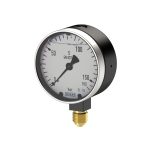
Isolates aggressive or hot media from the instrument.
Frequently asked questions
Why does my gauge show a different pressure than expected?
Usually it is the measuring point: between pump and consumer, valves and lines drop pressure. Check that the gauge really sits at the relevant point and that the range and accuracy class fit the job.
Why is my gauge filled with liquid?
That is usually glycerine. The fill damps vibration and fast pressure pulsation so the pointer stays steady and readable. In hydraulics this clearly extends the life of the movement.
Which accuracy class do I need in hydraulics?
For normal service class 1.0 is enough. For precise setting of relief valves class 0.6 is sensible. For test benches and calibration higher classes from 0.25 are common.
Find the right pressure measuring gear
When choosing, pay attention to range, accuracy class and protection against pressure spikes for your system.
Field-based selection
Recommendations from operating values and maker data.
Correct range
Scale matched to your system's working pressure.
Spike protection
Damping and diaphragm seals clearly explained.
Selection help
We help you choose the right products; technical details are clarified with the manufacturer.