
Controlling cylinder speed with flow valves
The speed of a pneumatic cylinder is set by air flow, not by pressure. One-way flow control valves throttle the exhaust air to give a smooth, even motion. This guide shows why meter-out control is almost always the right choice and how to avoid juddering and hard end stops.
View flow control valvesWhy is speed controlled through flow, not pressure?
Working pressure delivers the force, air flow sets the speed. A one-way flow control valve lets air pass freely in one direction and throttles it in the other. This limits how much air leaves the cylinder per unit of time without cutting the pressure and therefore the force. If the cylinder moves too fast, the rod judders or slams hard into the end position.
- Pressure = force: set with the regulator.
- Flow = speed: set with the flow control valve.
- One-way flow control: free in one direction, throttled in the other.
Meter-out or meter-in control?
With meter-out control the exhaust air is throttled while the supply air flows in freely. This creates a back pressure (air cushion) that guides the piston smoothly. With meter-in control the incoming air is restricted, so the piston lurches forward once the break-away force is overcome. For double-acting cylinders, meter-out is almost always the right choice.
How do I set the flow control valve correctly?
Start with the valve almost closed and open it step by step until the stroke and end position run cleanly and without juddering. Set each direction separately, since extend and retract have different areas and loads. In addition, the integral end-position cushioning catches the last few millimetres and protects the cylinder and attachments from hammering.
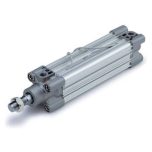
- Mount the flow control valve as close to the cylinder port as possible.
- Set extend and retract separately.
- Adjust end cushioning so the piston brakes softly.
Frequently asked questions
Meter-out or meter-in - which is better?
In most cases meter-out control. It creates a stabilising air cushion and guides the piston smoothly. Meter-in control makes double-acting cylinders lurch and is only used in special cases.
Why does my cylinder judder even with a flow valve?
Often the cylinder is controlled the wrong way (meter-in instead of meter-out) or the valve sits too far from the port. Static friction at very slow speed (stick-slip) also causes juddering. Meter-out control close to the cylinder usually solves it.
Can I set the speed through pressure?
No. Pressure sets the force, not the speed. A low pressure only weakens the cylinder and makes the motion less steady. For speed, always control the flow with a flow control valve.
Find the right flow control valves
Find flow control valves by control method, port size and end cushioning for your cylinder in our shop.
Field-tested sizing
Recommendations from maker data and field values.
Correct control method
Meter-out control for smooth, stable motion.
Soft end stops
End cushioning protects cylinder and attachments.
Selection help
We help you choose the right products; technical details are clarified with the manufacturer.