
How to Choose a Compressed Air Filter
A compressed air filter protects valves, cylinders and tools from water, oil and particles. The right mix of prefilter, fine filter and activated carbon filter decides service life and process reliability. This guide shows how to match filter stage, grade and condensate drain to your application.
View compressed air filtersWhich filter stages do I need?
Air treatment is staged: each filter type removes a different contaminant. A prefilter catches coarse particles and liquid condensate, a fine filter fine dust and oil mist, an activated carbon filter oil vapour and odours. Running everything through one ultra-fine filter clogs it far too fast. Stages are arranged in flow direction from coarse to fine.
How do I pick filtration grade and purity class?
The required grade depends on the application. Simple drives and tools are fine with 5 µm. Painting, packaging or control pneumatics need 1 µm or finer. For food contact or sensitive processes an activated carbon filter for oil-free air is required. The purity classes to ISO 8573‑1 state one value each for particles, water and oil.
- General pneumatics and tools: a 5 µm prefilter usually suffices.
- Painting and coating: 1 µm fine filter plus carbon against oil mist.
- Control and measuring: 0.01 µm microfilter for stable signals.
- Food and pharma: aim for oil-free air, ISO 8573‑1 class 1.
How do I manage condensate drain and pressure drop?
Separated condensate must leave the filter reliably. Manual valves get forgotten, semi-automatic drains open when depressurised, electronic level-controlled drains work without air loss and need little maintenance. Watch the pressure drop too: a clogged element eats working pressure and energy. A differential pressure gauge signals the element change in time.
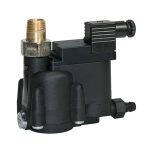 Choose the drain
Level-controlled drains lose no air, use manual drain only for low condensate.
View products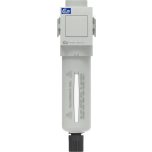 Watch pressure drop
Use a differential pressure gauge and keep the element below 0.2 bar loss.
More basicsSet flow rate and purity class together.
Frequently asked questions
In which order are compressed air filters arranged?
Always coarse to fine in flow direction: prefilter first, then fine or microfilter, and the activated carbon filter last. Each stage protects the next, so the fine elements last longer.
What does the micron rating on a filter mean?
The micron rating states the filtration grade, that is the size of particles still separated. 5 µm is a coarse prefilter, 1 µm a fine filter and 0.01 µm a microfilter for aerosols and oil mist.
Does a compressed air filter also remove water?
A filter separates liquid condensate and aerosols but not gaseous water vapour. For genuinely dry air with a defined pressure dew point you also need a refrigeration or adsorption dryer.
Find the right compressed air filter
Find compressed air filters by filter stage, grade and condensate drain for your application in our shop.
Vetted selection
Recommendations from maker data and ISO 8573.
Clean compressed air
Particles, oil and condensate removed on purpose.
Low pressure drop
Right body size for full flow.
Selection help
We help you choose the right products; technical details are clarified with the manufacturer.