
Throttle and Needle Valves for Fine Flow Adjustment
A throttle valve regulates flow through an adjustable orifice and so sets the speed of cylinders and motors. The needle valve is the finest form, with a long adjustment travel for precise metering of small flows. This guide covers function, selection and how it differs from a load-independent flow-control valve.
View hydraulic valvesHow does a throttle valve work?
A throttle valve creates flow resistance at an adjustable restriction and so limits the volume flow. Less flow means slower movement of the connected cylinder or motor. But the flow depends on the pressure drop across the restriction: as the load rises, the speed falls. This load dependence is the key difference from a controlled flow-control valve.
What sets the needle valve apart?
A needle valve uses a tapered needle that seats into a cone. The long, gently rising adjustment travel over several spindle turns allows very fine and highly repeatable setting of small volume flows. That makes it ideal for metering, flushing and fine-control tasks where a coarse throttle valve would react too abruptly.
- Long adjustment travel for sensitive, repeatable setting.
- Well suited to small volume flows and metering.
- Usually secured with a lock nut against unintended adjustment.
- As a throttle check valve, restricts one direction and flows freely the other.
When do I need a throttle check valve?
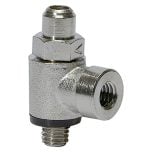
Often only one direction of travel should be throttled while the return stroke runs at full flow. A throttle check valve combines the restriction with a parallel check valve: in one direction the adjustable throttle acts, in the other the check opens and lets the oil flow freely. This lets you control the extend speed of a cylinder, for example, without slowing the retract.
 Meter-in
Throttle in the supply, works against the load, can chatter under an overrunning load.
Compare valvesThrottle in the return, supports the load and runs smoother, usually preferred.
Cylinder guideMatch direction, nominal size and viscosity to the application.
Frequently asked questions
What is the difference between a throttle valve and a flow-control valve?
A throttle valve is a plain, adjustable resistance: the flow changes with the pressure drop and therefore with the load. A flow-control valve holds the volume flow constant through a pressure compensator, so the speed stays the same even under changing load.
What is a needle valve used for in hydraulics?
For fine, highly repeatable control of small volume flows, such as metering, flushing or slow movements. The needle's long adjustment travel makes the setting more sensitive than a plain throttle valve.
Should I throttle on the meter-in or meter-out side?
With pushing loads, meter-in throttling can be enough. With overrunning or changing loads, meter-out is usually better because it keeps the cylinder under back pressure and stops the load running ahead.
Find the right throttle or needle valve
When choosing, pay attention to valve type, throttle direction and nominal size for your application.
Vetted selection
Recommendations from maker data and field values.
Right valve type
Throttle, needle or flow-control valve matched to the task.
Viscosity considered
Sizing for the hydraulic oil in use.
Selection help
We help you choose the right products; technical details are clarified with the manufacturer.