
Choosing suction cups for the workpiece
A suction cup must match the workpiece: shape, diameter and material decide whether the surface is held securely. An undersized or wrong cup tears off under acceleration or marks sensitive surfaces. This guide walks step by step through sizing suction cups by workpiece, holding force and vacuum level so parts stay held.
View suction cupsWhich cup shape fits the workpiece?
Cup shape decides how the cup seals against the surface. Flat cups hold flat, rigid surfaces such as sheet metal and glass securely. Bellows cups with folds compensate for height differences and grip curved or uneven parts. Oval cups spread the holding force over narrow profiles and strips without needing a large diameter.
How do I size diameter and holding force?
Theoretical holding force follows from the suction area and vacuum level. In practice keep a safety reserve of at least 2:1 for calm handling and 4:1 for fast motion or vertical gripping. Friction, acceleration and leakage reduce the usable force, so never size a cup at its theoretical limit.
- Set the workpiece weight and number of cups first.
- For a vertical surface or acceleration, apply a 4:1 reserve.
- Several small cups give more safety than one large cup.
Which cup material is the right one?
The elastomer decides marking, wear and media resistance. NBR is robust and economical for general handling. Silicone is heat-tolerant and food-safe but can leave silicone traces. For painted or sensitive parts, mark-free materials that leave no residue on the surface are the right choice.
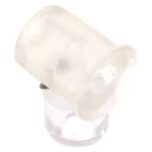
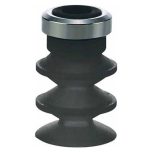 Mark-free
For painted and sensitive surfaces without residue.
Frequently asked questions
How many suction cups do I need per workpiece?
It depends on weight, size and stiffness. Spread the load over several cups so thin or flexible parts do not sag. Several small cups give more safety and stability than a single large one.
What does the safety reserve mean for a suction cup?
It is the ratio of theoretical holding force to the actual workpiece weight. A 2:1 reserve applies to calm handling and 4:1 to fast motion or vertical gripping, to cover friction and acceleration safely.
Flat cup or bellows cup - which is better?
Flat cups hold flat, rigid surfaces most stably. Bellows cups use their folds to compensate height differences and grip curved or uneven parts, as well as workpieces that should lift slightly on pick-up.
Find the right suction cup
When choosing, pay attention to shape, diameter and material for your workpiece and handling.
Vetted selection
Recommendations from maker data and field values.
Correct holding force
Diameter matched to weight and motion.
Safety reserve
Holding force and vacuum level clearly explained.
Selection help
We help you choose the right products; technical details are clarified with the manufacturer.