
Stroke length and piston rod buckling
At long stroke the piston rod of a pneumatic cylinder is loaded in buckling when fully extended, like a slender compression column. If the rod diameter is too small, the rod fails suddenly. This guide shows how stroke length, rod diameter and mounting interact and how to size the buckling safety factor correctly.
View pneumatic cylindersWhy does the piston rod buckle at long stroke?
When fully extended, the piston rod acts like a slender column loaded in compression. Once the thrust exceeds a critical limit, the rod deflects sideways and buckles. What matters is not the stroke alone but the free buckling length at full extension: the further the piston protrudes, the longer the unsupported part of the rod and the lower the permissible load.
How do I work out the permissible buckling load?
The critical buckling load follows the Euler equation: it rises with the modulus of elasticity of the steel and the second moment of area of the rod, but falls with the square of the free buckling length. Because the second moment of area grows with the fourth power of the diameter, the piston rod diameter is the strongest lever. Dividing the buckling load by the actual thrust gives the buckling safety factor.
- Work out maximum thrust from piston area times working pressure.
- Determine the free buckling length from full stroke and mounting type.
- Choose a rod diameter so the safety factor stays above 2.5.
- In borderline cases use the maker's buckling chart or a detailed calculation.
How does the mounting affect the free buckling length?
The mounting of the cylinder and rod end decides the free buckling length and thus the permissible load. A rigidly fixed foot with a guided rod end gives a short buckling length, while a free rod end doubles it. For the same rod the permissible load can therefore vary by more than a factor of four.
How do I avoid buckling problems in practice?
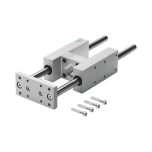
A shorter stroke or an intermediate stop clearly cuts the free buckling length.
Compare drivesIn the critical range recheck the buckling safety.
Frequently asked questions
At what stroke do I need to consider buckling?
A rough rule of thumb is a stroke of more than 15 times the piston rod diameter; the exact figure depends on thrust and mounting. For a standing cylinder with a free rod end you should recheck from just a few hundred millimetres of stroke.
How much buckling safety is enough?
A safety factor between 2.5 and 5 is common, and around 3.5 is often used. For shock loads, changing loads or unguided rods choose the higher value.
Does a larger bore help against buckling?
No, a larger bore actually raises the thrust at the same pressure and so increases the load. What works is a larger rod diameter, a shorter free buckling length or an added guide.
Size cylinders without buckling risk
For a safe design, stroke, piston rod diameter and mounting are what matters.
Safe buckling reserve
Sizing with a safety factor of 2.5 to 5.
Matched stroke
Rod matched to the free buckling length.
Vetted selection
Recommendations from maker data and field values.
Selection help
We help you choose the right products; technical details are clarified with the manufacturer.