
Selecting a Solenoid-Operated Hydraulic Directional Valve
A hydraulic solenoid directional valve steers the oil flow to a cylinder or motor. Spool symbol, nominal size, coil voltage and centre position must match the task, or the valve shifts poorly or overheats. This guide walks through the key selection criteria step by step.
View hydraulic valvesWhich spool symbol and nominal size do I need?
The way function describes ports and switching positions. A 4/2 valve has two positions and suits simple extend and retract. A 4/3 valve adds a third position, usually the centre at rest, and allows holding, bypass or float. The nominal size (NG 6, NG 10, NG 16) sets the possible flow rate and must match the cylinder speed.
Which coil voltage and control are right?
The coil sets how the valve is switched. Direct current (24 V DC) is the machine-building standard, shifts smoothly and tolerates frequent switching. Alternating current (230 V AC) shifts faster but draws high inrush current and can burn out if the armature jams. For reliable switching the available voltage must match the valve coil and the control system.
- Check the coil power draw (W) against the available power source.
- Choose a connector to ISO 4400 or a plug with switching-status indicator.
- For frequent switching prefer DC, as AC coils overheat when they stall.
How do I pick the centre position and wet-armature design?
On 4/3 valves the centre position decides the at-rest behaviour. A closed centre holds the cylinder in place, a tandem or bypass centre unloads the pump, and a float centre lets the cylinder move freely. Hydraulic solenoid valves run wet: the armature sits in oil that lubricates, cools and dampens the switching shock.
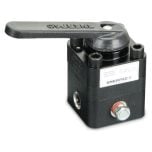
For pilot-operated valves and high flow, compare spool type and rated flow in the datasheet.
Frequently asked questions
What does the designation 4/3 mean on a directional valve?
The first number gives the count of ports, the second the count of switching positions. A 4/3 valve has four ports and three positions, usually with a centre position in the de-energised state.
Should I choose a DC or AC coil?
24 V DC is the standard in controlled systems, shifts smoothly and tolerates many cycles. AC shifts faster but draws high inrush current and can burn out if the armature jams. For frequent switching DC is the safe choice.
Why does my solenoid valve not shift cleanly?
Common causes are contaminated oil, wrong viscosity, too low a voltage or an undersized valve. Check filtration, coil voltage and whether the nominal size matches the flow rate.
Find the right hydraulic solenoid valve
When choosing, pay attention to spool symbol, nominal size and coil voltage for your application.
Right way function
Spool symbol matched to the motion task.
Reliable control
Coil voltage matched to control and switching rate.
Clean hydraulics
Viscosity and filtration clearly explained.
Selection help
We help you choose the right products; technical details are clarified with the manufacturer.