
Quick Exhaust Valves for Faster Actuation
A quick exhaust valve vents the cylinder chamber right at the port instead of pushing exhaust air all the way back through the tubing to the directional valve. The piston moves noticeably faster because back pressure drops immediately. This guide shows when a quick exhaust valve pays off and how to size and mount it correctly.
View pneumatic valvesHow does a quick exhaust valve work?
The quick exhaust valve sits directly on the cylinder port and has three ports: supply (P), cylinder (A) and a large exhaust outlet (R). During pressurization air flows from P to A and holds a sealing diaphragm closed. When the control reverses and the pressure at P drops, the diaphragm opens the path from A straight to atmosphere. The exhaust air no longer travels the long way through tubing and directional valve but escapes right at the valve.
When is it worth using?
A quick exhaust valve speeds up strokes where the exhaust side slows the piston. That covers fast feeds, ejectors, clamping and sorting tasks as well as long lines. Just make sure the faster motion is mechanically controlled - without end-position cushioning the piston hits harder.
- Long or thin tubing between directional valve and cylinder.
- Fast ejector, clamping or sorting movements.
- Large cylinder volumes that generate a lot of exhaust air.
- Only one stroke direction needs speeding up - one valve per chamber.
How do I choose size and mounting?
Flow is decisive: the exhaust cross-section should be at least as large as the cylinder ports, otherwise the benefit is lost. Mount the valve as close to the cylinder as possible, ideally screwed straight into the port. A silencer on the R port lowers the noise level but must not throttle the exhaust stream.
Choose an exhaust cross-section equal to or larger than the cylinder port.
Compare valves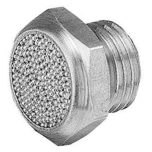 Pick a silencer
Cut noise without throttling the exhaust stream.
Frequently asked questions
Why does the cylinder move faster with a quick exhaust valve?
The exhaust air escapes straight to atmosphere at the cylinder instead of flowing back through the long tubing to the directional valve. Back pressure in the exhausting chamber drops immediately, so the piston moves faster.
Where exactly is the quick exhaust valve mounted?
As close to the cylinder as possible, ideally screwed straight into the cylinder port. The shorter the path between chamber and exhaust outlet, the greater the speed gain.
Do I need one or two valves per cylinder?
One valve per stroke direction you want to speed up, so one per cylinder chamber. If only the extend stroke needs to be faster, a single valve on that chamber is enough.
Find the right quick exhaust valve
When choosing, pay attention to port size, mounting and silencer for faster and safe cylinder motion.
More speed
Shorter cycle times through direct exhaust at the cylinder.
Correct port size
Flow matched to the cylinder port.
Safe design
End cushioning and impact energy clearly explained.
Selection help
We help you choose the right products; technical details are clarified with the manufacturer.