
Choosing Push-In Fittings for Pneumatics
Push-in fittings connect tube and valve in seconds, but the wrong size or seal costs pressure and service life. Tube outer diameter, thread type, body material and shape must match the system. This guide shows how to pick the right push-in fitting and fit it leak-free for good.
View push-in fittingsWhich tube size and thread do I need?
Push-in fittings are ordered by tube outer diameter, not inner diameter. Common metric sizes are 4, 6, 8, 10, 12 and 16 mm, plus imperial 1/8 to 1/2 inch. At the valve or manifold the port thread also matters: metric M5 or M7 for small valves, imperial R or G threads for larger ports. Most wrong orders come from confusing inner and outer diameter, or R and G threads.
Which body material and seal suit the medium?
The body is usually nickel-plated brass or engineering plastic. Brass is robust, pressure-proof and handles oil and vibration. Plastic is light, corrosion-free and ideal in damp or chemically loaded zones. The seal sets the temperature and media range: NBR covers standard compressed air, while FKM tolerates higher temperatures and oily air better.
- For oily or hot air, check the maker's media and temperature approval.
- In food and cleanroom areas choose corrosion-free or approved materials.
- Prefer brass for joints exposed to vibration.
Straight, elbow or swivel fitting?
Body shape decides footprint and tube routing. Straight push-in fittings are the base form. Elbow fittings at 90 degrees save space on tight valve islands. Swivel versions let the tube align freely and relieve moving axes. For fast changeovers, quick couplings also help by disconnecting a line without a tool.
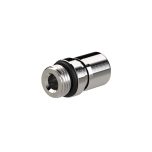
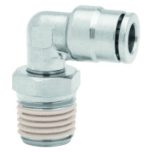
We help with size, thread and material for your system.
Frequently asked questions
Do I order a push-in fitting by inner or outer tube diameter?
Always by tube outer diameter. A 6 mm fitting suits a tube measuring 6 mm on the outside. The inner diameter follows from the wall thickness and does not drive the order.
Why does my push-in joint hiss even with the right size?
Usually the tube was not pushed fully to the stop, was cut at an angle, or has a burr. Recut the tube square and push it firmly home. If it still leaks, check the seal and thread type.
Can I mix R and G threads?
Mechanically both engage, but they seal differently. R threads seal tapered on the flank, G threads need a washer or O-ring. For a reliable seal, match the thread type to the correct sealing method.
Find the right push-in fitting
When choosing, pay attention to tube size, thread, material and body shape for your system.
Vetted selection
Recommendations from maker data and field values.
Correct size
Tube size and thread clearly matched.
Leak-free fit
Material and seal matched to the medium explained.
Selection help
We help you choose the right products; technical details are clarified with the manufacturer.