
Hydraulic Pump Sizing by Displacement and Flow
The pump is the heart of every hydraulic power unit: displacement, drive speed and working pressure decide flow, cylinder speed and drive power. An undersized pump makes the system slow, an oversized one wastes energy and oil. This guide walks through the calculation step by step.
View power unitsHow do displacement and flow rate relate?
A pump's displacement (swept volume) is given in cm³ per revolution. Multiplied by the drive speed it yields the theoretical flow rate. The formula is Q = V × n × η, where Q is the usable flow in l/min, V the displacement in cm³/rev, n the speed in rpm and η the volumetric efficiency. Worked example: a pump of 8 cm³/rev at 1450 rpm and η = 0.92 delivers about 10.7 l/min.
How do I derive displacement from the application?
Sizing starts at the actuator. The required cylinder speed and piston area give the needed flow, and from a known drive speed the displacement. Pick the next larger catalogue frame size and check that the motor and valves can handle the flow.
- Flow Q = piston area A × speed v (mind the units).
- Displacement V = Q / (n × η) - take the speed from the motor datasheet.
- Add a 10 to 15 percent reserve for leakage and pressure drop.
- For rapid traverse and press stroke, base sizing on the larger of the two flows.
Which pump type fits the pressure and duty?
The pump type follows from pressure level, flow and control need. Gear pumps are rugged and cheap for constant demand. Vane pumps run quietly in the mid pressure range. Axial piston pumps reach high pressures and can be varied to match flow to demand and save energy.
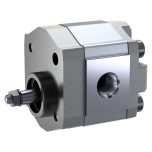
High pressure and variable for demand-based flow.
Frequently asked questions
How do I calculate the flow rate of a hydraulic pump?
Multiply the displacement (cm³/rev) by the drive speed (rpm) and the volumetric efficiency, then divide by 1000 for l/min. Example: 10 cm³/rev × 1450 rpm × 0.9 / 1000 gives about 13 l/min.
Why does my pump deliver less oil than calculated?
The theoretical flow ignores internal leakage. As pressure rises the volumetric efficiency drops, so less oil arrives in practice. Calculate with the datasheet efficiency and a 10 to 15 percent reserve.
Which oil viscosity should I choose for the pump?
For most industrial applications ISO VG 46 is a good starting point. Oil that is too thin raises leakage, too thick strains the suction side. Stay within the viscosity range approved by the pump maker for your operating temperature.
Size the right hydraulic pump
When choosing, pay attention to displacement, flow rate and pump type for your power unit.
Vetted calculation
Sizing from maker data and field values.
Correct displacement
Flow matched to the required speed.
Energy efficiency
Pump type and control matched to demand.
Selection help
We help you choose the right products; technical details are clarified with the manufacturer.