
Pressure Dew Point Explained
The pressure dew point tells you the temperature at which moisture in your compressed air condenses under working pressure. If the coldest point in the network falls below this value, condensate forms and damages valves, cylinders and tools. This guide explains the term, the difference from the atmospheric dew point and how to pick the right dryer.
View air dryingWhat exactly is the pressure dew point?
The pressure dew point (PDP) is the temperature at which water vapour in compressed air turns into liquid condensate under working pressure. If the air cools anywhere in the network below this value, water drops out. That is why the pressure dew point must sit safely below the lowest expected ambient temperature, for example in unheated halls or outdoor lines.
- Pressure dew point = moisture content of the air in its compressed state.
- Rule of thumb: keep the PDP at least 5 to 10 °C below the coldest point in the network.
- Always read maker figures against the stated reference pressure (usually 7 bar).
Pressure dew point or atmospheric dew point?
Both values describe the same moisture content but at different pressures. The pressure dew point applies in the compressed network, the atmospheric dew point after expansion to ambient pressure. Because compressed air holds a smaller volume and thus more water per volume, the pressure dew point is higher than its matching atmospheric dew point. For sizing the drying stage, the pressure dew point is what counts.
Which dryer reaches which pressure dew point?
The dryness you need depends on the application. Ordinary workshop pneumatics run fine on a refrigeration dryer at around +3 °C PDP. Where frost, painting, medical use or fine controls are involved, you need a desiccant dryer at -40 °C or lower. The dryer sits after the compressor and cooler, backed by filters that remove oil and particles.
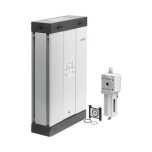
Set flow, pressure and lowest temperature together.
How does the pressure dew point relate to ISO 8573?
The ISO 8573‑1 standard sorts compressed-air quality into purity classes for solids, water and oil. For humidity it sets an allowed pressure dew point per class. That lets you specify the required dryness clearly instead of just asking for dry air.
Frequently asked questions
Why does condensate still form despite a dryer?
Usually a section of pipe runs colder than the dryer's pressure dew point, for example in an unheated hall. Choose a dryer whose PDP is at least 5 to 10 °C below the lowest temperature in the network.
What does a pressure dew point of +3 °C mean?
At working pressure, water only condenses once the air cools below +3 °C. For frost-free indoor rooms that is usually enough. With frost risk or outdoor lines a lower value is needed.
Is a refrigeration dryer enough for my application?
For general workshop pneumatics without frost, a refrigeration dryer at around +3 °C PDP is fine. For control air, painting, medical use or outdoor lines, a desiccant dryer at -40 °C or lower makes sense.
Find the right compressed-air drying
When choosing, pay attention to pressure dew point, dryer type and ISO 8573 class for your network.
Clear to standard
Humidity classes mapped cleanly to ISO 8573-1.
Right dew point
PDP matched to the lowest temperature in the network.
Condensate protection
Protects valves, cylinders and tools.
Selection help
We help you choose the right products; technical details are clarified with the manufacturer.