
One-Way Flow Control: Meter-Out vs Meter-In
A one-way flow control valve sets the speed of a pneumatic cylinder without losing force. The key is the metering direction: meter-out throttles the exhaust and holds the cylinder against an air cushion, while meter-in suits only special cases. This guide shows when each variant fits and how to set it cleanly.
View pneumatic valvesHow does a one-way flow control valve work?
The valve combines an adjustable restrictor with a check valve. In one flow direction the air is throttled, in the opposite direction it passes freely through the check valve. So it limits speed in one direction only, without blocking full flow on the return stroke. For a double-acting cylinder you usually fit two valves, one at each cylinder port.
Why is meter-out usually the right choice?
With meter-out control the air leaving the cylinder is throttled while the inlet air flows in freely. This builds a back pressure on the exhaust side that acts as an air cushion and guides the piston smoothly. It prevents the dreaded lurching (stick-slip) and gives even motion even under changing loads. For almost all double-acting cylinders this is the standard solution.
Meter-in control instead limits the incoming air. The cylinder starts hesitantly and tends to jump under load because no stabilising air cushion forms. Meter-in makes sense almost only with single-acting cylinders, very small volumes or when a defined slow start is required.
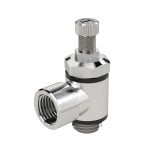
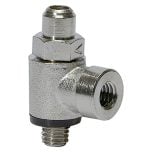
We help with metering direction and size for your cylinder.
How do I select and mount the valve correctly?
The one-way flow control valve sits best directly at the cylinder port, often as a push-in fitting. That keeps the air volume between restrictor and piston small so control stays precise. Port size follows the cylinder bore and tube diameter. Set both valves of a cylinder separately so extend and retract each get the right speed.
- Mount the valve directly at the cylinder, not at the directional valve.
- Check the metering direction: for meter-out the valve throttles the cylinder exhaust.
- Open the needle slowly until the target speed is reached, then lock it.
- Adjust both stroke directions independently.
- With oil-mist lubrication choose media-resistant seals.
Frequently asked questions
Meter-out or meter-in - which do I use?
For double-acting cylinders almost always meter-out. The back pressure on the exhaust side forms an air cushion and guides the piston smoothly. Meter-in suits only single-acting or very small cylinders.
Why does my cylinder judder despite the flow control?
Usually the inlet is throttled instead of the exhaust, or the valve sits too far from the cylinder. Switch to meter-out and mount the valve directly at the cylinder port so a stable air cushion can form.
How many valves do I need per cylinder?
A double-acting cylinder needs two, one at each port, so extend and retract are set separately. A single-acting cylinder gets by with one valve.
Find the right one-way flow control valve
When choosing, pay attention to metering direction, port size and mounting for smooth cylinder motion.
Vetted selection
Recommendations from field values and maker data.
Smooth motion
Meter-out control for even cylinder movement.
Correct size
Port matched to bore and tube diameter.
Selection help
We help you choose the right products; technical details are clarified with the manufacturer.