
ISO 21287 compact cylinders for tight spaces
ISO 21287 compact cylinders are much shorter than ISO 15552 standard cylinders and fit where installation space is tight. Bore, stroke, installed length and mounting decide force, stiffness and assembly. This guide walks through the key selection criteria step by step.
View compact cylindersWhat defines an ISO 21287 compact cylinder?
ISO 21287 defines double-acting compact cylinders with standardized bores and mounting dimensions but a much shorter body than the ISO 15552 profile cylinders. The short build saves space in dense fixtures, grippers and handling modules. Because the mounting dimensions are standardized, cylinders from different makers can be swapped without changing the design.
Which bore and stroke do I need?
The bore sets the force, the stroke sets the travel. Theoretical thrust equals piston area times working pressure; for sizing, plan a reserve of about 30 to 50 percent so friction and pressure swings are covered. Compact cylinders are built for short to medium strokes - watch piston-rod buckling on long strokes.
- Calculate the required force and add a 30 to 50 percent reserve.
- Choose the stroke only as long as needed to limit buckling and length.
- On pulling loads, account for the smaller annular area on the rod side.
How do I plan mounting and cushioning?
Mounting and end-of-stroke cushioning decide stiffness and smooth running. Compact cylinders are usually mounted directly through threaded holes in the housing or with a flange. At high mass or speed, adjustable cushioning or an external shock absorber secures soft end positions and prevents bouncing.
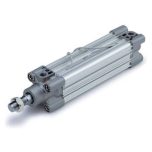
Use the sensor slot for magnetic sensors to check stroke ends.
Frequently asked questions
How does ISO 21287 differ from ISO 15552?
ISO 21287 describes compact cylinders with a very short body, ISO 15552 the longer profile cylinders. Both have standardized mounting dimensions, but the compact cylinder saves space while the profile cylinder covers longer strokes and accessories.
How do I calculate a compact cylinder's force?
Theoretical force is piston area times working pressure. At 6 bar a 32 mm bore delivers about 480 N. Plan a 30 to 50 percent reserve for friction and pressure swings.
Can I swap compact cylinders from different makers?
The installation and mounting dimensions per ISO 21287 are standardized, so a swap is often possible. Still check cushioning, sensor slot and piston-rod thread in the datasheet, as these can differ.
Find the right ISO 21287 compact cylinder
When choosing, pay attention to bore, stroke, mounting and cushioning for your installation space.
Standardized sizes
Selection to ISO 21287 mounting and installation dimensions.
Space saved
Short body for tight fixtures and grippers.
Force sized right
Bore and reserve matched to the required load.
Selection help
We help you choose the right products; technical details are clarified with the manufacturer.