
How to select ISO 15552 profile cylinders
An ISO 15552 profile cylinder is the standard actuator in machine building because its interface and mounting dimensions are standardized. Bore, stroke, cushioning and mounting decide force, smooth travel and interchangeability. This guide walks step by step through selecting the right cylinder and staying flexible across suppliers.
View pneumatic cylindersWhat exactly does ISO 15552 define?
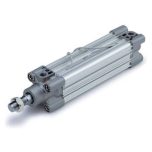
ISO 15552 sets the mounting and interface dimensions for profile cylinders with bores from 32 to 320 mm. Standardized are the piston-rod thread, the position of mounting flanges and the tie-rod spacing, but not the internal design. This lets you swap a cylinder from Aventics, Airtec, E.MC or YPC without rebuilding the bracket. It protects you from depending on a single supplier.
How do I set bore and stroke?
The bore sets the force, the stroke sets the travel. Theoretical push force is piston area times working pressure; for pull force use the area reduced by the piston rod. Always add a 20 to 30 percent reserve for friction and load peaks. With long strokes and side load, check the piston rod for buckling.
- Take the required force from the application plus a 20 to 30 percent reserve.
- For strokes above 500 mm, check the piston rod for buckling strength.
- Pull force is lower than push force because the rod removes area.
Which cushioning and mounting fit my application?
At the end of stroke the moving mass must be decelerated. Fixed elastic pads suffice for small masses, adjustable air cushioning is the standard, and high energy needs external shock absorbers. Choose the mounting by how force is introduced: rigid via foot or flange, articulated via clevis or trunnion when the load swings.
 End cushioning
Adjustable air cushioning for medium masses, shock absorbers at high energy.
Compare cylinders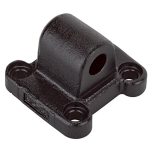
Have mass, speed and cycle rate assessed together.
Frequently asked questions
Are ISO 15552 and ISO 6431 interchangeable?
In their interface and mounting dimensions, yes. ISO 15552 replaced the older ISO 6431 and kept the envelope. So an ISO 6431 cylinder fits the same brackets as an ISO 15552 cylinder.
How do I calculate a cylinder's force?
Push force is piston area times working pressure. A 32 mm bore cylinder delivers about 483 N at 6 bar. For pull force subtract the piston rod area and plan a 20 to 30 percent reserve.
When do I need an external shock absorber?
When the kinetic energy at the end of stroke exceeds the internal cushioning, for example with a large mass or high speed. The external shock absorber protects the cylinder and extends its life.
Find the right ISO 15552 cylinder
Find ISO 15552 cylinders by bore, stroke, cushioning and mounting for your application in our shop.
Standardized selection
Recommendations to ISO 15552 and field values.
Cross-brand fit
Interchangeable across Aventics, Airtec, E.MC and YPC.
Correct force
Bore sized to match the load.
Selection help
We help you choose the right products; technical details are clarified with the manufacturer.