
Selecting guided cylinders for side loads
A plain round cylinder tolerates almost no side load; its piston rod jams and wears out fast. A guided cylinder carries side load and bending moment through two parallel guide rods and holds the load against rotation. This guide shows how to choose guide type, stroke and size for your application.
View guided cylindersWhy use a guided cylinder at all?
A standard cylinder's piston rod is built for axial force, not side load. When a side force acts at the rod end, it creates a bending moment that loads the rod bearing and seal on one side. The rod jams, runs unevenly and the seals wear out early. A guided cylinder spreads that load over two external guide rods and protects the drive itself.
- Takes up side loads without loading the piston-rod seal.
- Anti-rotation for grippers, stops and handling modules.
- Higher positioning accuracy through a low-play guide.
- Longer service life because the bending moment stays off the seal.
Plain bearing or ball guide?
The guide type decides friction, load capacity and accuracy. Plain bearings are cheap, tolerant of dirt and damp out shocks, but carry more play and friction. Recirculating ball guides run smoothly and very precisely and take high moments, yet react more sensitively to contamination and impact loads.
How do I size stroke, dimensions and ports?
The load comes first: side force and bending moment at the tool set the size and guide. Stroke follows, because as stroke grows the guide rods deflect more and the allowable side load drops. Piston diameter gives the axial force at a given pressure; the air ports and end-of-stroke cushioning complete the sizing.
Check side force and bending moment against the maker's chart for your stroke.
Compare cylinders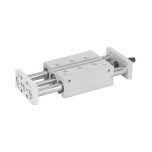
Match port size and end cushioning to the mass and speed.
- Apply the maximum load at the real lever arm to the cylinder, not just the part weight.
- Always read the allowable side load at the stroke you use from the datasheet.
- At high speed choose adjustable or hydraulic end-of-stroke cushioning.
- Size port threads and air volume for the required cycle time.
Frequently asked questions
When do I need a guided cylinder instead of a standard cylinder?
As soon as a side load or torque acts at the rod end, for example with grippers, stops or off-center loads. The guided cylinder takes up side force and bending moment through its guide rods and relieves the piston rod and seal.
Plain bearing or ball guide - which is better?
The plain bearing is robust, cheap and tolerant of dirt but has more play. The ball guide runs more precisely and smoothly and carries higher moments, but it needs protection from contamination in rough environments.
Why does the allowable side load drop with stroke?
With a longer stroke the guide rods extend further and deflect more under side load. That is why makers state the allowable side load as a function of stroke, not as a fixed value.
Find the right guided cylinder
Find guided cylinders by guide type, size and stroke for your side loads and cycle time in our shop.
Vetted selection
Recommendations from maker data and field values.
Load done right
Side force and bending moment matched to the stroke.
Long service life
Seal relieved, guide matched to the environment.
Selection help
We help you choose the right products; technical details are clarified with the manufacturer.