
Pneumatic versus elastic end cushioning
At the end of every stroke the piston slams into the end position. Without cushioning this causes shock, noise and wear. The choice between elastic cushioning and adjustable pneumatic cushioning decides smoothness, cycle time and service life. This guide shows which principle fits your mass, speed and kinetic energy.
View pneumatic cylindersWhat cushioning types exist on a pneumatic cylinder?
At the end of the stroke the kinetic energy must be absorbed in a controlled way. Small cylinders use elastic cushioning pads or rings that spring the impact. Larger or faster drives use pneumatic cushioning: air is trapped just before the end position and released slowly through a throttle so the piston eases in. For very high energies an external hydraulic shock absorber is added.
How do I size cushioning by mass and speed?
Kinetic energy is the deciding factor: it rises linearly with mass and with the square of speed. Doubling the speed quadruples the energy at the end of stroke. So check the moving mass, piston speed and any extra force from the working pressure. If the energy exceeds the internal cushioning limit, an external shock absorber is required.
- Capture the moving mass including tool and fixture.
- Estimate piston speed from stroke and cycle time.
- Check the cylinder's allowable energy absorption in the datasheet.
- If exceeded, choose an external absorber or a larger bore size.
How do I set pneumatic cushioning correctly?
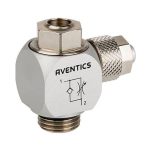
Adjustable cushioning is set with a throttle screw. Start almost closed and open it step by step until the piston eases in without a hard stop and without rebound. Too much cushioning lengthens the cycle time, too little creates shock. Check the setting at working pressure and real load, not when running unloaded.
For high energy, review bore size and cushioning together.
Frequently asked questions
How do I know the end cushioning is too weak?
A hard, audible impact and vibration at the end of stroke show weak cushioning. The piston clearly slams in. Close the throttle a little, or choose an external shock absorber if the energy is too high.
When is elastic cushioning enough and when do I need pneumatic?
Elastic pads suffice for low mass and speeds up to about 0.5 m/s. For higher mass, speed or varying conditions, adjustable pneumatic cushioning is the safe choice.
Does strong cushioning lengthen the cycle time?
Yes. The more you cushion, the slower the piston eases into the end position. Set it only as strong as needed so the piston lands softly without adding unnecessary cycle time.
Find the right end cushioning
Find cylinders with elastic or pneumatic end cushioning sized by mass, speed and energy in our shop.
Vetted sizing
Recommendations from energy and maker data.
Correct energy
Mass and speed assessed properly.
Less wear
A soft landing protects end cap and bearing.
Selection help
We help you choose the right products; technical details are clarified with the manufacturer.