
Double-Rod Through-Rod Cylinder Guide
A double-rod cylinder carries the piston rod through both end caps, so the effective areas on both sides of the piston are equal. As a result extend and retract move at the same speed with the same force, which greatly simplifies control and synchronous motion. This guide covers the principle, typical applications and the key selection criteria.
View hydraulic cylindersWhat defines a double-rod cylinder?
In a double-rod cylinder the piston rod passes through both end caps, which is why it is also called a through-rod cylinder. Because the same annular area acts on both sides of the piston, force and speed are identical in both directions of travel. In an ordinary differential cylinder the bore side is larger than the rod side, so extend and retract run at different speeds.
Where does the through-rod pay off?
The double-rod cylinder shines wherever a motion must run exactly the same in both directions, or where the load should be guided from both ends. The second, protruding rod often serves as a precise guide or as a mount for position measurement.
- Synchronous drives where several cylinders must run at the same speed.
- Reciprocating motions such as feed tables or shuttle tables.
- Guided loads with support on both ends against buckling and side loads.
- Mounting of position sensors or cam switches on the second rod end.
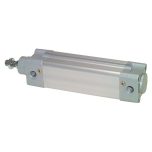
The free rod end cleanly carries a measuring system or switch cam.
How do I size and seal it correctly?
The key figures are the required force from pressure and annular area, the stroke length with a buckling check, and the working pressure. Because both rods must be sealed, the double-rod cylinder has two rod seals and therefore more friction and one more potential leak path than a single-rod cylinder. Keep the oil clean, since both seals are sensitive to contamination.
Frequently asked questions
What is the difference between a double-rod and a differential cylinder?
The double-rod cylinder has a through rod, so both sides have equal area and force and speed are identical in both directions. The differential cylinder has only one rod, its bore side is larger, so extend and retract run at different speeds.
Why does a double-rod cylinder need the same oil volume in both directions?
Because the same annular area acts on both sides of the piston, it displaces the same volume per unit of travel. Flow demand is therefore equal on extend and retract, which makes it easy to synchronise several cylinders.
Does the through rod have drawbacks?
It needs space on both sides, has two rod seals with more friction and one extra potential leak path. In return you gain synchronous motion, guidance from both ends and a free rod end for measuring systems.
Find the right double-rod cylinder
Find double-rod cylinders by area, stroke, buckling check and sealing for your synchronous drives in our shop.
Equal area
Force and speed identical on both sides explained.
Correct sizing
Stroke, buckling check and rod diameter accounted for.
Sealing in focus
Two rod seals and oil cleanliness clearly named.
Selection help
We help you choose the right products; technical details are clarified with the manufacturer.