
Cylinder Speed and Flow Demand
The speed of a hydraulic cylinder follows a simple rule: piston speed equals flow divided by the effective piston area. Once you know the area and the stroke per second you need, you can size the pump flow directly. This guide shows the calculation, the difference between extend and retract, and the practical limits.
View hydraulic cylindersHow are speed and flow related?
Piston speed equals flow divided by the effective area: v = Q / A. The flow Q comes from the pump, and on extension A is the full piston area. Double the flow and the speed doubles. Choose a larger bore and the speed drops for the same flow, because the area grows.
Why do extend and retract need different flows?
On extension the full piston area acts, while on retraction only the annular area does, because the rod takes area away. For the same speed, extension therefore needs more oil than retraction. The ratio of piston to annular area is the area ratio and is often between 1.4:1 and 2:1 on standard cylinders. At a fixed flow the cylinder retracts faster than it extends.
- Example bore 63 mm, rod 36 mm: extend needs 18.7 l/min, retract only about 12.6 l/min for 0.1 m/s.
- Area ratio of this cylinder is about 1.5:1, so retraction is correspondingly faster.
- Oil volume per stroke is area times stroke length, key for cycle time and tank size.
What limits speed in practice?
Not every calculated speed is allowed. Standard cylinders are usually rated up to about 0.5 m/s; higher values need end cushioning or special designs so the piston does not slam into the cap. Excess piston speed creates pressure spikes and wear on the seal and bearing. You control the actual speed through the flow, for example with a flow control valve or proportional technology.
A meter-out flow control valve keeps speed stable even under changing load.
View actuators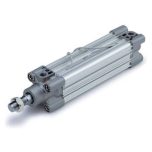 End cushioning
Cushioning brakes the piston before the cap and guards against pressure spikes.
Compare cylindersMatch bore, rod and pump together for cycle time and force.
Frequently asked questions
How do I calculate the flow for a target cylinder speed?
Multiply the effective piston area by the target speed: Q = A × v. For a 63 mm bore (31.2 cm²) at 0.1 m/s this gives about 18.7 l/min on extension.
Why does my cylinder retract faster than it extends?
On retraction only the annular area acts, because the rod removes area. At the same flow the speed is therefore higher. The relationship is described by the area ratio, often 1.4:1 to 2:1.
How fast may a standard hydraulic cylinder run?
Without special measures the usual limit is about 0.5 m/s. Higher speeds need end cushioning or special designs, otherwise you risk hard impacts and wear. The exact figure is in the datasheet.
Size the right hydraulic cylinder
Find hydraulic cylinders by bore, rod and flow for your cycle time and force in our shop.
Traceable formulas
Calculation from area, speed and flow explained clearly.
Correct bore
Area matched to speed and available pump flow.
Safely sized
Speed limits and end cushioning taken into account.
Selection help
We help you choose the right products; technical details are clarified with the manufacturer.