
Sizing a Compressed Air Receiver Tank
The air receiver tank buffers demand peaks, smooths pressure swings and cuts how often the compressor cycles. A tank that is too small lets the compressor cycle constantly and the pressure drop, while an oversized one ties up capital needlessly. This guide shows how to determine the right tank size step by step.
To the guidesWhy does the system need a tank at all?
The air receiver is the system's energy store. It covers short demand peaks without the compressor having to start at once and keeps the line pressure stable. At the same time the tank separates condensate as the air cools, protecting downstream treatment and tools. Four jobs stand out: buffering, smoothing, cycle relief and water separation.
- Buffer for demand peaks so pressure does not drop on load changes.
- Smoothing of pressure pulsation from piston compressors.
- Fewer start-stop cycles and so a longer compressor life.
- Condensate separation as the compressed air cools in the tank.
How do I calculate the right tank size?
The exact size depends on output, the allowed switching frequency and the switching differential. With piston compressors the maximum starts per hour limit service life, so you size the tank so the motor does not start more than about 20 to 30 times per hour. The larger the differential between cut-in and cut-out pressure, the smaller the tank can be.
Which factors influence the sizing?
Output is not the only thing that counts. The compressor type decides whether a large buffer is needed: piston compressors cycle and need more volume, while variable-speed screw compressors deliver steadily and get by with less. Fluctuating demand, long pipe runs and the maximum allowed pressure drop at the consumer also feed into the choice.
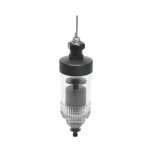 Condensate
Plan a drain so water does not reach the air network.
What else should I watch in practice?
A larger tank costs little more but gives noticeably more reserve and fewer compressor starts. Plan an automatic condensate drain, keep the safety valve and gauge accessible and set the tank up frost-free. With strongly fluctuating demand an extra buffer close to the largest consumer often pays off.
- When in doubt choose one size up, the extra cost is small.
- Fit an automatic condensate drain at the lowest point.
- Mount the safety valve and pressure gauge with clear access.
- Set the tank up frost-free and with clearance from the wall.
Frequently asked questions
What tank size do I need for my compressor?
As a rule of thumb allow about 1 to 1.5 litres of tank volume per litre per minute of output. A compressor delivering 3 to 4 m³/min pairs well with a 500 litre tank. With strongly fluctuating demand it is better to size one step larger.
What happens if the air receiver is too small?
The compressor cycles too often, the line pressure drops on load peaks and tools lose power. Frequent start-stop also shortens the life of the compressor motor. A larger tank usually fixes this.
Can I use two smaller tanks instead of one large one?
Yes, several tanks can run in parallel and add up to the total volume. An extra buffer near the largest consumer supports pressure there specifically. Each tank still needs its own safety valve and condensate drain.
Size the right air receiver tank
Our guide covers tank size, switching differential and treatment for your system.
Vetted sizing
Recommendations from output data and field values.
Correct volume
Tank size matched to compressor capacity.
Safety in view
Safety valve, inspection and condensate clearly explained.
Selection help
We help you choose the right products; technical details are clarified with the manufacturer.