
Improving Compressed Air Energy Efficiency
Compressed air is the most expensive energy form on the shop floor: roughly 70 to 90 percent of a compressor's life-cycle cost is electricity. Leaks, excessive working pressure and unused waste heat quietly drive the bill up. This guide shows the most effective levers to cut consumption for good.
To the guidesWhere do I lose the most compressed air?
Leaks are the single largest loss in almost any compressed-air network. They run around the clock, even with production stopped, and quickly add up to 20 to 30 percent of total consumption. Leaking couplings, porous hoses, worn seals and open blow-off points are the most common sources. A single 3 mm hole at 6 bar can cost a four-figure sum in electricity per year.
- Listen for hissing across the network during production shutdowns.
- Use an ultrasonic leak detector to locate leaks while running.
- Replace leaking push-in couplings and quick connectors at once.
- Swap open blow nozzles for efficient nozzles with lower consumption.
How do I lower the working pressure sensibly?
Every extra bar costs energy: cutting pressure by 1 bar saves roughly 6 to 8 percent of drive power, depending on the plant. Many networks run at 7 or 8 bar out of habit even though the consumers need far less. Check the actual demand at the critical consumer and set the network pressure just above it. Local pressure regulators feed special high-demand points on their own.
Feed high-pressure areas locally instead of raising the whole network.
Understand layout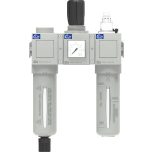 Service regulators
Check service units and pressure regulators regularly.
How do I recover energy through waste heat?
Almost all the electrical energy fed into a compressor turns into heat. On water-cooled units or those with a heat exchanger, up to 90 percent of this heat can be recovered and used for heating, hot water or process heat. This does not cut the compressed-air consumption itself, but it markedly improves the plant's overall energy balance.
- Plan heat recovery already when selecting the compressor.
- Keep short paths between compressor and heat sink.
- Match running hours and heat demand in time.
How do I avoid losses from wrong sizing?
Undersized lines and fittings create a permanent pressure drop that is expensively offset through the network pressure. Undersized receivers cause frequent compressor cycling and poor efficiency. Size pipe cross-sections generously, keep flow velocities low and use a receiver large enough to buffer load peaks.
- Run main lines as a ring main to roughly halve pressure loss.
- Keep flow velocity in the main line below about 6 m/s.
- Match receiver size to the compressor's delivery and switching cycle.
- Drain condensate consistently so the cross-section stays clear.
Frequently asked questions
How do I find compressed-air leaks without expensive gear?
With production stopped the network is quiet enough to hear leaks hiss, so large leaks are found quickly. For hidden or small leaks during operation an ultrasonic leak detector is worthwhile, as it makes the flow noise audible.
How much does lowering the pressure really save?
As a rule of thumb each bar less cuts drive power by about 6 to 8 percent. Dropping the network from 8 to 6.5 bar therefore saves around 10 percent energy, provided all consumers stay safely supplied.
Is heat recovery worthwhile even on small compressors?
Yes, as soon as a real heat demand is nearby, for example space heating or hot water. On air-cooled units the exhaust air can often be used for space heating with little effort. Payback depends mainly on the running hours.
Cut compressed-air costs for good
Our guide covers leak management, pressure optimisation and the selection of efficient components.
Leaks under control
Systematic search instead of costly steady losses.
Right pressure
Network pressure aligned to real demand.
Waste heat used
Energy recovered instead of wasted.
Selection help
We help you choose the right products; technical details are clarified with the manufacturer.