
FRL Air Preparation Unit: Setup and Selection
An air preparation unit conditions the compressed air ahead of the consumer: the filter removes condensate and particles, the regulator holds a constant working pressure, and the lubricator adds oil mist for tools that need it. Sized wrong, pressure collapses or dirty air destroys valves and cylinders. This guide walks through setup and selection step by step.
View FRL unitsWhat is an FRL unit made of?
FRL stands for Filter, Regulator and Lubricator. The three blocks sit in series along the flow: first the filter cleans water and dirt from the air, then the regulator sets a stable working pressure, and finally the lubricator adds oil mist when needed. Many plants today run oil-free components and leave the lubricator out.
Which filter grade and regulator function do I need?
Filter grade follows the consumer. Standard cylinders and tools manage with 5 to 40 µm, while valve terminals and instrumentation demand fine filters in the micron range, sometimes with activated carbon against oil vapour. The purity classes for particles, water and oil are defined in standard ISO 8573. The regulator should hold its setpoint even as demand fluctuates.
- Choose filter grade for the most sensitive consumer on the line.
- Prefer an automatic condensate drain for continuous operation.
- Use a relieving regulator when the pressure has to be lowered.
How do I size port and flow?
Port size and flow decide the pressure drop. An undersized unit throttles the air volume and the working pressure collapses on every stroke. Base sizing on the air demand of all consumers in l/min plus the allowed residual pressure loss. As a rule of thumb the unit port matches the nominal size of the main line, and one size up when in doubt.
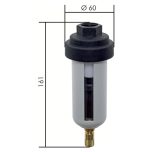
Determine air demand and port size together.
What matters for installation and maintenance?
Mount the unit upright and accessible ahead of the consumer so the filter bowl drains downward. Watch the flow direction, usually marked with an arrow. Check the filter element and bowl regularly and meter the oil mist per the maker's guidance. That keeps the air clean and the pressure stable.
- Install the unit upright with the filter bowl pointing down.
- Respect the flow direction (arrow); do not swap inlet and outlet.
- Replace the filter element when the pressure drop rises.
- Check the condensate drain regularly, especially in humid environments.
Frequently asked questions
Do I need a lubricator in every system?
No. Many modern valves and cylinders are lubricated for life and run oil-free. A lubricator is only needed when tools or components explicitly require oil mist. Once a line is lubricated, keep the lubrication in place.
Which filter grade is right?
It follows the most sensitive consumer. Standard cylinders and tools are fine with 5 to 40 µm. Valve terminals, sensors and measuring air need fine filters of 1 µm or finer, plus an activated carbon filter against oil vapour.
Why does pressure collapse despite an FRL unit?
Usually the unit is too small for the air demand or the filter is clogged. Both create pressure drop. Choose a larger port size and check the filter element for contamination.
Find the right FRL unit
We supply FRL units matched to filter grade, port size and flow for your system.
Vetted selection
Recommendations from maker data and field values.
Clean compressed air
Filter grade matched to the most sensitive consumer.
Stable pressure
Regulator and flow correctly sized and explained.
Selection help
We help you choose the right products; technical details are clarified with the manufacturer.