
Hydraulic Accumulator Types and Sizing
A hydraulic accumulator buffers energy, dampens pressure spikes and holds volume ready for load peaks. Whether bladder, piston or diaphragm depends on pressure range, flow and dynamics. This guide shows how to pick the type, pre-charge pressure and size for your power unit.
View power unitsWhich accumulator type fits my application?
The type decides pressure range, dynamics and usable volume. Bladder accumulators react fast and suit pulsation damping and frequent load changes. Piston accumulators offer large usable volume and high pressure ratios but respond slower due to piston friction. Diaphragm accumulators are compact and cheap for small volumes and fast cycles.
How do I set the pre-charge pressure correctly?
The pre-charge pressure (p0) sets how much oil the accumulator takes in and gives back. As a rule of thumb, p0 is about 90 percent of the minimum working pressure (p1). Too high a pre-charge makes the bladder slam against the valve; too low wastes usable volume. Always check p0 with the accumulator depressurised and at working temperature.
- Set pre-charge p0 to roughly 0.9 x p1 (min working pressure).
- Use dry nitrogen only, charge and test with a proper charging kit.
- Account for temperature: p0 rises and falls with oil and ambient temperature.
- Check the pre-charge yearly or per the maintenance schedule.
How do I calculate usable volume and size?
Usable volume follows from the gas law relation between pre-charge, minimum and maximum working pressure. The smaller the gap between p1 and p2, the larger the accumulator must be. Use the isothermal case for fast load changes and the adiabatic case for slow ones. Keep the pressure ratio p2/p0 below about 4:1 for bladder accumulators.
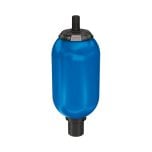 Check pressure ratio
Keep bladder types below 4:1, otherwise choose a piston type.
Compare accumulatorsFor safety and energy accumulators, have the calculation reviewed.
Frequently asked questions
Which accumulator type suits pulsation damping?
The bladder type, because it reacts very fast and damps small volume swings. For large energy amounts or high pressure ratios a piston accumulator is the better choice.
Why may I only charge the accumulator with nitrogen?
Nitrogen is dry and inert. Compressed air or oxygen could form an ignitable mixture together with oil mist. That is why only dry nitrogen is used.
How often must I check the pre-charge pressure?
At least once a year or per the maker's maintenance schedule. A pressure loss in the gas side noticeably reduces usable volume and points to a faulty bladder or seal.
Size the right hydraulic accumulator
We supply bladder and piston accumulators matched to type, pre-charge pressure and size for your power unit.
Vetted sizing
Recommendations from pressure range and field values.
Correct volume
Usable volume matched to p1, p2 and cycle.
Safe operation
Pre-charge and depressurising clearly explained.
Selection help
We help you choose the right products; technical details are clarified with the manufacturer.